
Last updated November 4, 2026
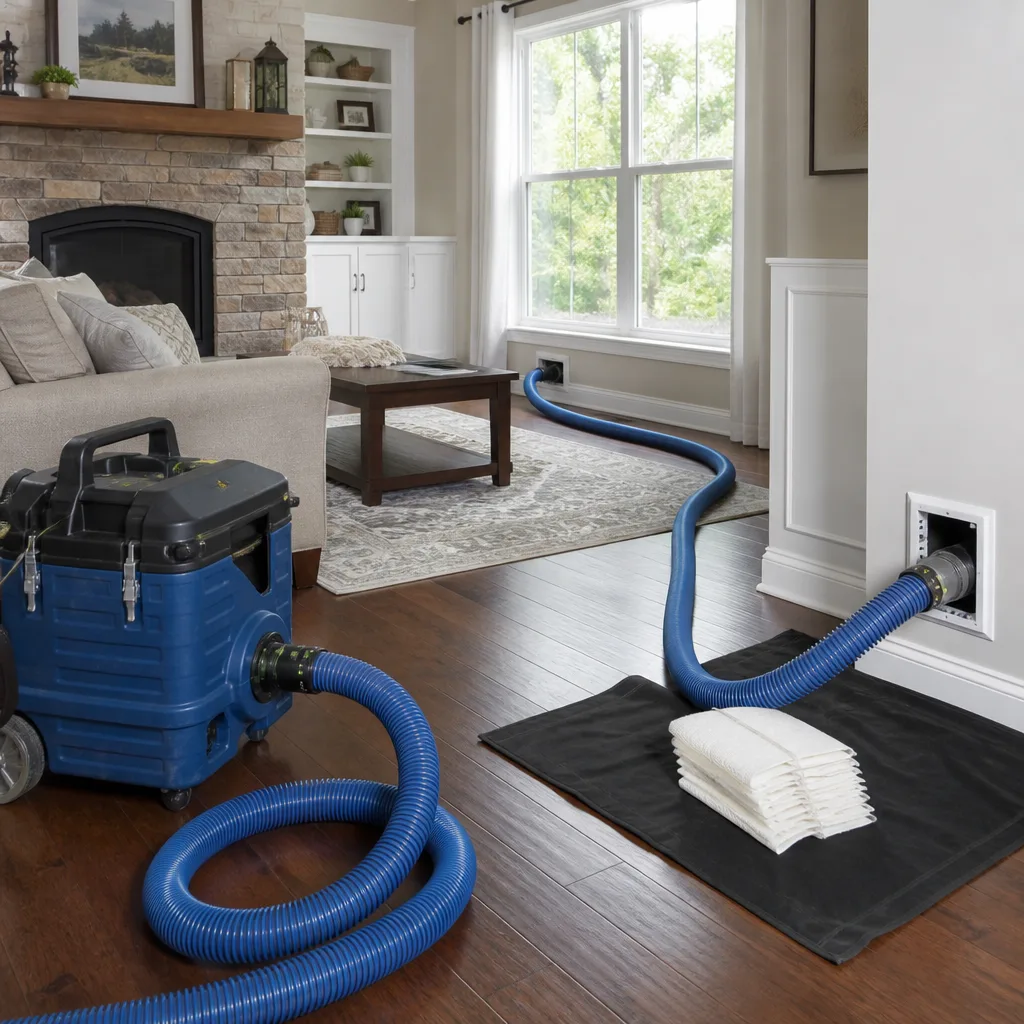 Whole-home duct cleaning
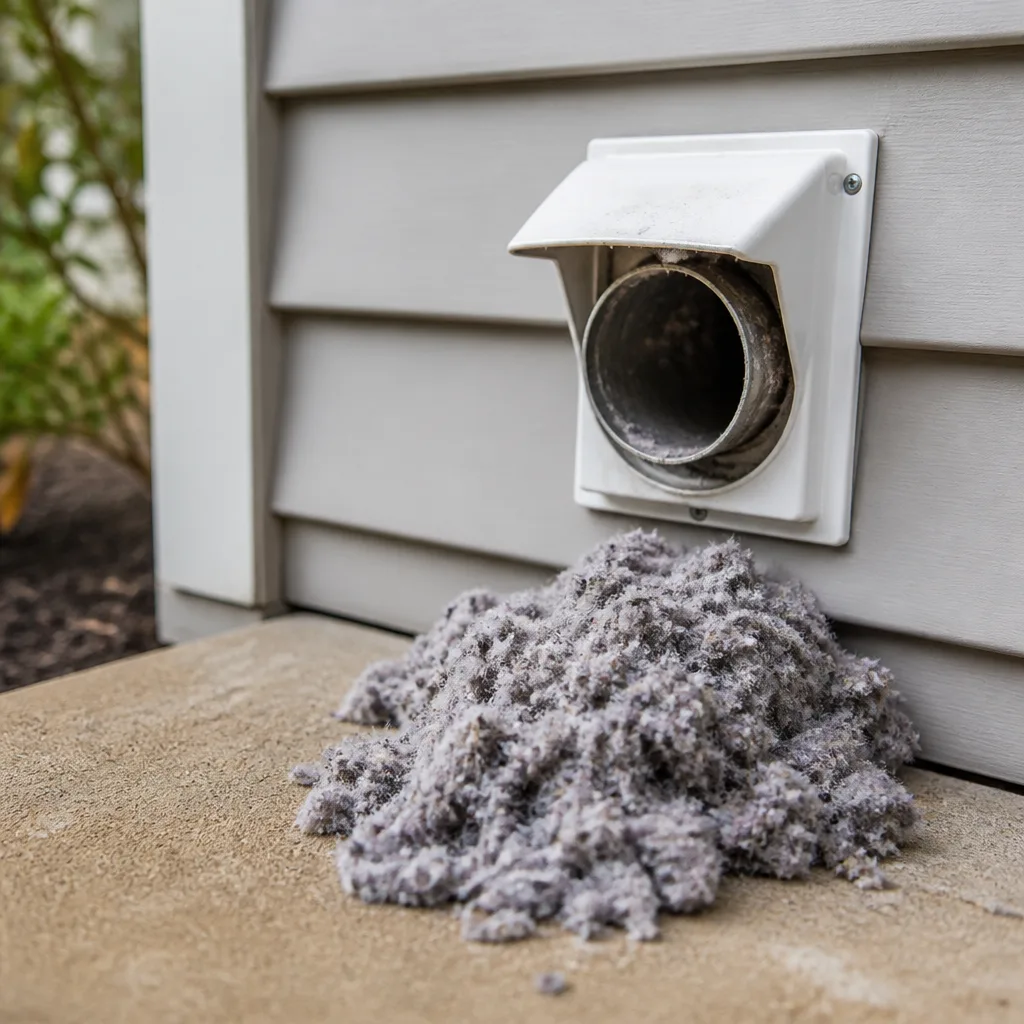 Dryer vent cleaning
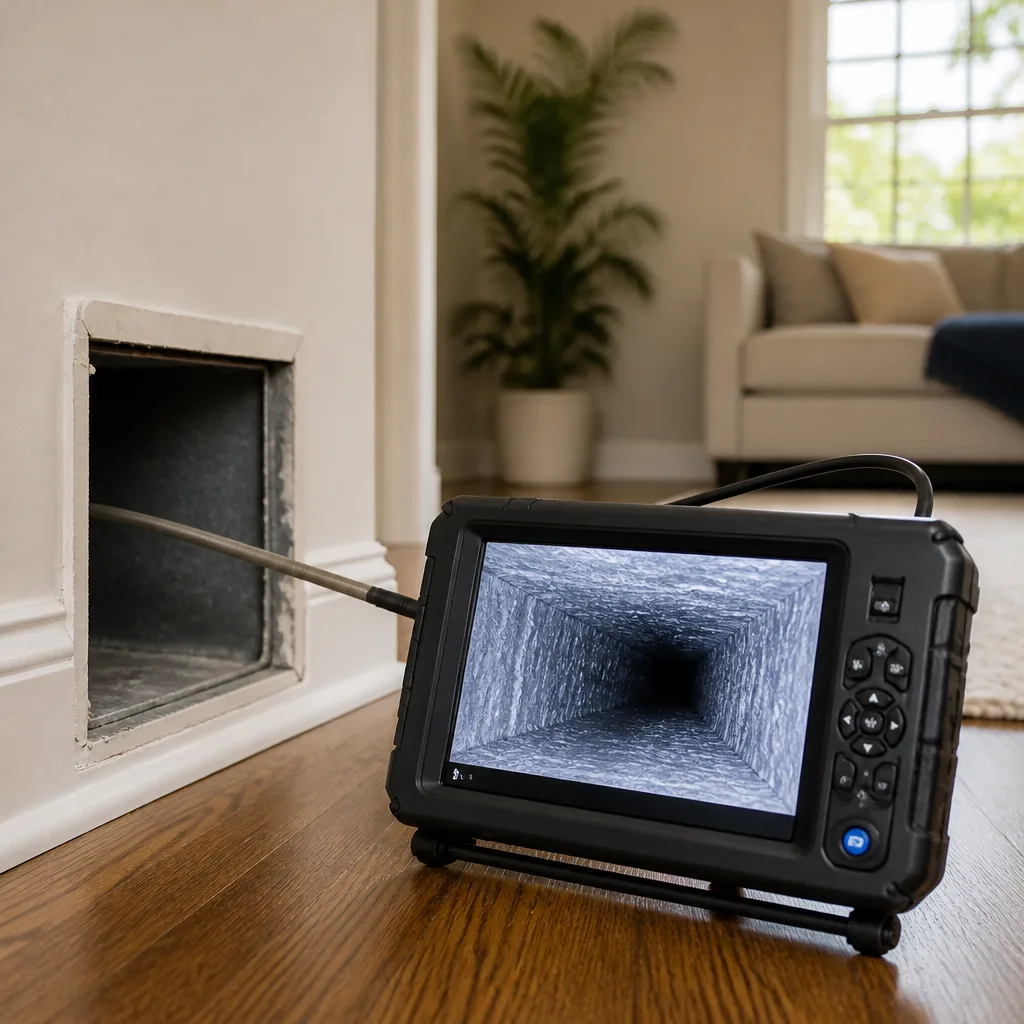 Camera inspection
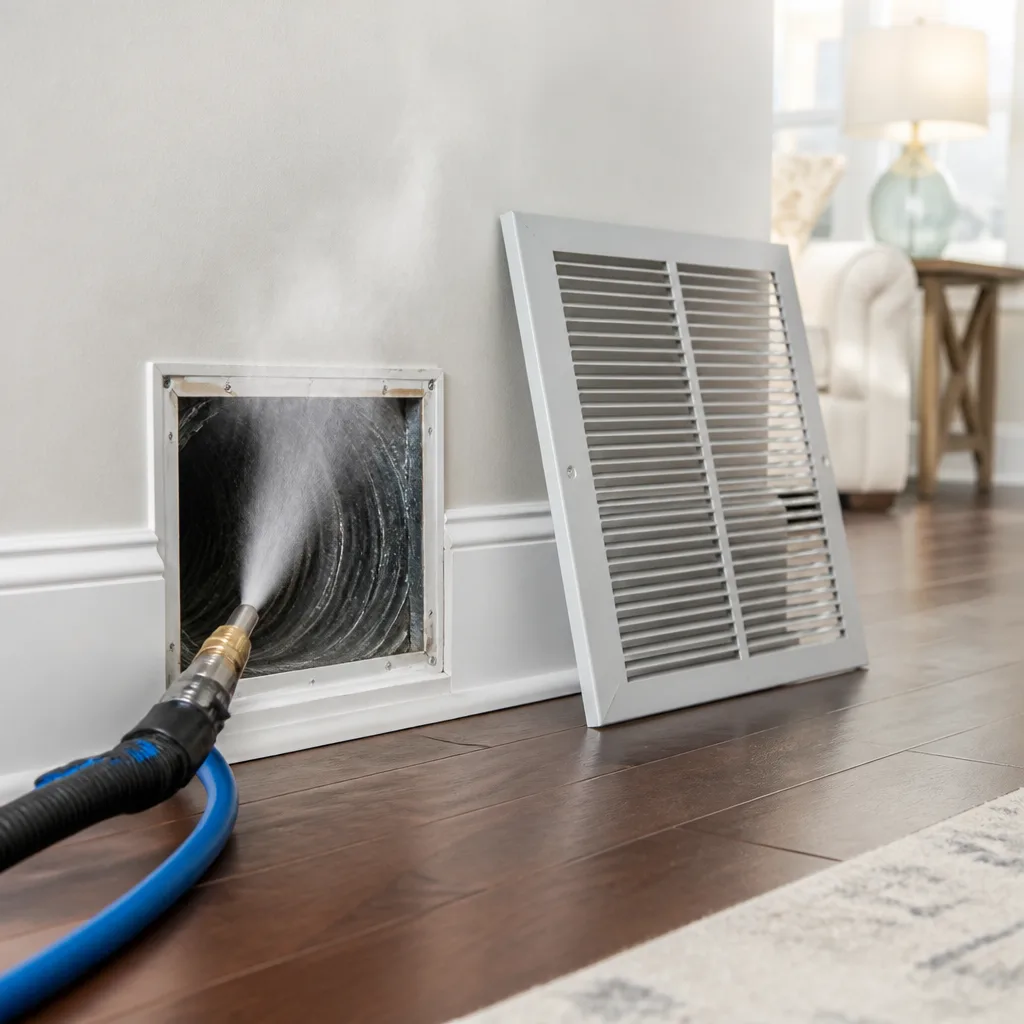 Sanitizing & deodorizing
Whole-system duct and dryer vent check with before-and-after photos - you see exactly what came out of your vents
That "$99 whole-house special" is a bait ad - the real number appears once they are in your hallway, or the "clean" is a shop-vac at the register. We photograph the inside of your ducts before and after instead.
The Complete Guide to Air Duct Cleaning in Pomona
The EPA doesn’t recommend routine air duct cleaning, and that single sentence has convinced a lot of Pomona homeowners to skip a service they actually need. But the EPA’s position comes with a qualifier most people never read: contamination combined with moisture or structural damage is a different problem entirely. Our experience in Pomona’s older housing stock tells us most homes here fall into the second category. This guide explains how your duct system works as an integrated unit, why cleaning alone fails when the ducts themselves are compromised, and what a proper job should include from start to finish.
Quick Answer
Air duct cleaning in Pomona removes accumulated dust, debris, and biological growth from your HVAC distribution system using negative-pressure extraction and contact cleaning methods. A proper job addresses the full system: supply and return ducts, registers, plenum, coil surfaces, and blower compartment. The key difference between a real cleaning and a blow-and-go is whether the technician scrubs duct walls mechanically and whether the system’s negative pressure captures what comes loose instead of pushing it back into your living space.
Styles & brands we work with
- Whole-home duct cleaning
- Dryer vent cleaning
- Camera inspection
- Sanitizing & deodorizing
Table of Contents
- How Pomona’s Climate Shapes Duct Contamination
- Damaged Ducts vs. Dirty Ducts: Why the Distinction Matters
- Contact Cleaning vs. Blow-and-Go: What Actually Works
- Reading Airflow Balance Before Cleaning Begins
- What a Complete Duct Cleaning Includes Beyond the Ducts
- Dryer Vent Cleaning as Fire Prevention, Not an Upsell
- How Often Does Duct Cleaning Really Need to Happen?
- What Air Duct Cleaning Costs in Pomona
How Pomona’s Climate Shapes Duct Contamination
Pomona sits in the San Gabriel Valley, where summer temperatures routinely climb past 90°F and the Santa Ana winds push dry, dusty air through the region from October through March. That combination produces a contamination profile different from what you’d find in a coastal city or a humid climate. Your AC system runs hard for months, pulling outside air across the coil and through the return ducts, and everything airborne in that air ends up somewhere in the system.
Here’s what Pomona’s specific conditions do to ductwork:
- Fine dust accumulation: The dry inland air keeps particulate matter light and mobile. It doesn’t clump the way humid-climate dust does. It settles in duct runs, on coil fins, and inside the blower compartment, and every system cycle stirs a portion of it back into your rooms.
- Wildfire smoke residue: When smoke from regional fires drifts into the valley, your HVAC system filters some of it but not all. Smoke particles are small enough to pass through standard filters and deposit as a fine film on duct surfaces. Over multiple fire seasons, that film builds and can carry odors.
- Heat-accelerated biological growth: In Pomona’s warm months, any moisture present in the system becomes a breeding ground faster than it would in a cooler climate. Even minor condensation at the coil or a small leak at a duct joint creates conditions where mold and bacteria multiply quickly.
- Blower compartment loading: The blower fan pulls a constant stream of air across its housing. Dust collects on the fan blades themselves, reducing efficiency and throwing particles downstream every time the system starts.
None of this means your home is unusually dirty. It means the climate in Pomona produces a specific kind of contamination, and understanding that is the first step toward deciding what your system actually needs.
Damaged Ducts vs. Dirty Ducts: Why the Distinction Matters
Here’s the thesis of this entire guide: most Pomona homeowners don’t have dirty ducts. They have damaged ducts that also happen to be dirty. The two problems look similar from the outside, but treating only the contamination while leaving the damage in place means the problem returns within a season or two.
Think about what your ductwork actually is. It’s a connected series of metal or flex conduits running through unconditioned spaces, often an attic that reaches 130°F in a Pomona summer. Every joint, every seam, every connection point is a potential failure site. And when a joint separates or a section of flex duct tears, two things happen simultaneously:
- The system pulls unconditioned air in. A leak on the return side draws attic air, dust, insulation particles, and whatever else lives up there directly into your air handler. Your filter never sees this air. It bypasses every barrier you’ve set up.
- Conditioned air escapes. A leak on the supply side pushes cooled or heated air into the attic instead of your rooms. That’s money leaving your system, and it forces your HVAC to work harder to hit your thermostat setting.
When a technician cleans a system with undiagnosed leaks, the cleaning itself becomes pointless. The negative pressure doesn’t hold. Contaminants pulled loose during cleaning get re-deposited, and the underlying leak keeps feeding new dust into the system within weeks.
This is why we built our service around the ability to air duct cleaning and repair in the same visit. The Rotobrush contact-cleaning system scrubs what’s there, and if we find separated joints, torn flex, or failed connections, we fix them before the system goes back into service. A clean system with an open leak is still a dirty system in waiting.
Contact Cleaning vs. Blow-and-Go: What Actually Works
The cheap duct cleaning industry operates on a simple principle: move air fast enough and debris will come loose. That’s true for loose dust and obvious debris. It’s completely false for the kind of contamination that actually affects indoor air quality.
Here’s the problem. The inside surfaces of your ducts develop a layer of adhered material over time. Dust settles, moisture causes it to stick, oils from cooking and household products add a tacky component, and before long you have a film that resists airflow. A blower or shop vac connected to a register doesn’t remove that film. It blows across it, dislodges the loosest fraction, and leaves the rest exactly where it was. Some operators make this worse by agitating the air and trusting the air handler’s own blower to push debris toward a vacuum, which means a meaningful portion of what comes loose ends up recirculated into the house.
Contact cleaning is different. Our Rotobrush system uses rotating brushes that physically touch the duct walls. The bristles scrub the adhered film loose, and the system’s vacuum extraction pulls it out of the duct run immediately. The brush works the surface, not just the air above it.
The second part of the equation is negative pressure. A proper job connects a Nikro HEPA negative-air machine to the duct system, creating a containment-grade pressure differential. The air in the ducts moves toward the extraction point, not toward your living room. This is the same principle used in professional abatement environments, where containment and controlled airflow are non-negotiable. When we run the Rotobrush through a duct under Nikro negative pressure, anything the brushes dislodge gets captured and removed rather than redistributed.
The filtration matters too. Abatement Technologies filtration standards mean the air exhausted from the system during cleaning is filtered to HEPA levels. You’re not trading duct contamination for airborne contamination during the cleaning itself.
If you’re evaluating duct cleaning companies in Pomona, ask these questions:
- Do you mechanically scrub the duct walls, or do you rely on air pressure alone?
- What extraction equipment do you use, and does it create true negative pressure in the duct system?
- What filtration standard applies to the air exhausted during cleaning?
- Can you show me documentation of what you found and what you removed?
Most companies will answer the first question vaguely and the rest not at all. That tells you what you need to know.
Reading Airflow Balance Before Cleaning Begins
Before we put any equipment in a duct system, we assess how the system is performing. Airflow balance is the single most useful diagnostic signal for duct health, and it costs nothing to observe.
Here’s how to read the basic signals yourself:
- Check register flow room by room. Hold a tissue or a piece of paper near each supply register with the system running. Rooms that should be conditioned but show weak flow compared to others often indicate a crushed, disconnected, or obstructed duct on that branch.
- Listen for whistling or rushing sounds. High-pitched air noise at a register usually means the duct is undersized for the airflow it’s receiving, or a damper is partially closed. It’s a sign of resistance, and resistance means pressure, and pressure finds leaks.
- Check return air path. If doors close and suddenly the system sounds different or flow drops, the return path may be inadequate. In Pomona’s older homes, many systems rely on an undercut door or a single central return, and that design creates its own set of pressure problems.
- Feel for temperature difference between rooms. A room that’s consistently five or ten degrees off from the rest of the house, despite adequate register flow, often has duct leakage somewhere between the air handler and the room itself.
These observations tell you where to look before any cleaning starts. A technician who skips this step and just starts running equipment through registers is treating symptoms without understanding the system.
In our experience, homes in Pomona’s older neighborhoods show two common patterns: separated duct joints in attic runs, and crushed flex duct where someone stored boxes or ran new wiring through the attic after the original installation. Both are fixable. Both dramatically affect how the system moves air. And both render a cleaning-only visit largely pointless.
What a Complete Duct Cleaning Includes Beyond the Ducts
The word “ducts” in “duct cleaning” is misleading. Your HVAC distribution system includes several components that hold and shed contamination, and if any of them are skipped, the system re-contaminates quickly. A complete job addresses all of them.
Here’s the full scope of what should be cleaned and why each part matters:
- Supply and return ducts: These are the obvious parts, but the distinction matters. Supply ducts carry conditioned air to your rooms. Return ducts carry room air back to the air handler. Both need contact cleaning, because both hold adhered material, and a return-duct cleaning that skips the supply side is pointless.
- Registers and grilles: These are the visible faces of the system, and they’re usually caked with a mix of dust and household residue. They also restrict airflow when they’re dirty, which forces the blower to work harder.
- The plenum: This is the central chamber where the air handler connects to the ductwork. It sees the highest velocity airflow in the entire system, and its walls collect everything that doesn’t make it into the ducts. A dirty plenum re-contaminates the system within days.
- Coil surfaces: The evaporator coil sits in the air stream and condenses moisture whenever you run AC, which is most of the year in Pomona. Dust sticks to wet coil fins, builds into a mat, and becomes exactly the kind of moisture-plus-contamination condition that concerns the EPA. Dirty coils also reduce cooling efficiency noticeably.
- The blower compartment: The fan blades and housing collect dust constantly. Dirty blades move less air. A blower that struggles to move air pushes the system out of balance, and the contamination it sheds goes straight into your supply ducts.
If a technician quotes you a duct cleaning that doesn’t mention the coil, plenum, and blower, you’re not getting a duct cleaning. You’re getting a partial treatment that will look good in photos and mean very little for your air quality.
We also work around Honeywell and Aprilaire IAQ equipment regularly. Those systems, when installed, sit upstream or downstream of the ducts, and a technician who understands how they function knows that cleaning methods need to account for the equipment connected to the system. If your home has integrated filtration, humidification, or dehumidification, the cleaning scope should include those interfaces, not just the bare duct runs.
Dryer Vent Cleaning as Fire Prevention, Not an Upsell
Your dryer vent is a duct, but it deserves its own section because the stakes are different. Lint accumulates in dryer vents faster than any other duct in your home, and lint is remarkably flammable. The National Fire Protection Association identifies failure to clean dryer vents as a leading cause of home clothes-dryer fires. That’s not an efficiency issue. That’s a safety issue.
Here’s what happens in a neglected dryer vent:
- Lint builds up at bends, transitions, and the exterior termination point.
- The airflow that carries moisture out of the dryer gets restricted.
- The dryer runs hotter because it can’t exhaust properly.
- Lint near the heating element or in the hot exhaust stream reaches ignition temperature.
The timeline from clean vent to fire hazard varies with the length of the run, the number of bends, and what you dry. In our experience, a clogged or partially clogged dryer vent is one of the most common problems we find in Pomona homes, often alongside systems that were cleaned but never had the vent checked at all.
We offer dryer vent cleaning as a dedicated fire-prevention service. It’s not an add-on afterthought. It gets the same contact-cleaning approach as the HVAC ducts, with a focus on the full run from dryer to exterior termination point. If the vent is crushed, separated, or improperly terminated, we repair it. A clean vent that still can’t exhaust properly hasn’t solved the problem.
If you haven’t had your dryer vent cleaned in the last year, or you notice your clothes taking longer to dry than they used to, start there. The fix is straightforward and the alternative is genuinely dangerous.
How Often Does Duct Cleaning Really Need to Happen?
The honest answer is that there’s no universal schedule. The EPA doesn’t recommend routine cleaning on a fixed calendar interval, and we agree with that position. What we tell Pomona homeowners is that duct cleaning should happen when conditions indicate it, not when a coupon says it’s time.
Here are the specific conditions that justify cleaning:
- Visible dust buildup on registers or grilles: If the visible parts are caked, the hidden parts are worse.
- Post-renovation or post-construction: Drywall dust, sawdust, and insulation particles get pulled into the return ducts during any substantial work. This dust is fine enough to become airborne every time the system runs.
- Known moisture event or water damage in the system: Any time water has entered the ducts or pooled at the coil, cleaning should follow remediation of the moisture source.
- Visible mold growth on or inside duct surfaces: This is the condition where the EPA’s guidance is unambiguous. Contamination plus moisture requires action.
- Occupants with unexplained respiratory symptoms: If allergy symptoms or breathing issues are worse at home and improve elsewhere, the HVAC system is a reasonable place to investigate.
- Airflow problems that cleaning would address: If diagnostics show buildup restricting airflow, cleaning restores system function.
What we don’t recommend is cleaning on an arbitrary schedule just because enough time has passed. Some Pomona homes genuinely need it within a few years. Others with good filtration, sealed ducts, and clean surroundings can go much longer. The system’s condition, not the calendar, is what matters.
After cleaning, a few habits extend the useful life of the work. Change your filter on schedule. Consider upgrading your filtration if you’re running the cheapest filters available. And keep the area around your return registers free of dust and debris. These steps cost almost nothing and make a measurable difference.
What Air Duct Cleaning Costs in Pomona
Duct cleaning pricing is where the industry’s bait-and-switch reputation comes from, and it’s the question homeowners are most wary of asking. Let’s talk about it directly.
In Pomona, a legitimate whole-system duct cleaning typically falls in these ranges depending on home size and system complexity:
- Smaller single-story homes (up to 1,500 sq ft, single system): typically $400 to $700
- Mid-size homes (1,500 to 2,500 sq ft, one or two systems): typically $600 to $1,000
- Larger homes or multiple systems: typically $900 to $1,500+
- Dryer vent cleaning as a separate service: typically $150 to $300
These are whole-system prices, not per-vent prices. If a company quotes you a per-vent price, walk away. Per-vent pricing is how low-ball offers turn into large invoices once the technician is on site. The number of vents in your home isn’t the primary driver of the work involved; the system’s complexity and condition are.
Why the range? Because every system is different. A simple ranch-style home with short, accessible duct runs costs less than a two-story home with two air handlers and attic ductwork that’s difficult to access. Homes with known leakage or damage will have additional repair costs on top of the cleaning itself, which is why we diagnose before we quote whenever possible.
The other factor is the equipment and method. A company using a shop vac and a rotating brush attachment can’t charge what a company using Rotobrush contact-cleaning equipment and Nikro HEPA negative-air machines charges, because the work isn’t comparable. You’re paying for the method, and the method is what determines whether the cleaning actually holds.
Our estimate is free, and the written estimate sets the final price. No per-vent games, no surprise line items. You’ll know what the job costs before any equipment comes off the truck.
Common Mistakes to Avoid
- Hiring on price alone. Duct cleaning is one of those services where the cheapest option and the most expensive option can differ by hundreds of dollars for identical-sounding work. The difference is in the equipment, the method, and whether the technician addresses the full system. Cheap duct cleaning is usually worse than no duct cleaning, because it can dislodge contamination and leave it airborne.
- Accepting a quote without a system inspection. A company that quotes over the phone without seeing the system is guessing. The real condition of your ducts determines the price, and that requires looking at the system itself.
- Skipping the coil and blower. As covered above, the ducts are only part of the system. A job that leaves the coil and blower dirty has cleaned the pipes but not the source.
- Ignoring known duct damage. If you know a duct is separated or crushed and you schedule a cleaning anyway, you’re paying for a service that can’t hold. Fix the structure and clean what’s there.
- Treating dryer vents as an afterthought. The dryer vent is the most dangerous duct in most homes. Skipping it while cleaning the HVAC ducts addresses comfort while ignoring a genuine fire hazard.
- Not asking what equipment will be used. “Duct cleaning” is an unregulated term. Ask specifically about contact cleaning, negative pressure, and filtration. If the answers are vague, the service will be too.
- Believing a cleaning will fix airflow problems caused by damage. Cleaning restores airflow lost to buildup. It doesn’t fix airflow lost to crushed ducts, separated joints, or undersized returns. Those are repair issues, and they need repair, not air pressure.
See the difference
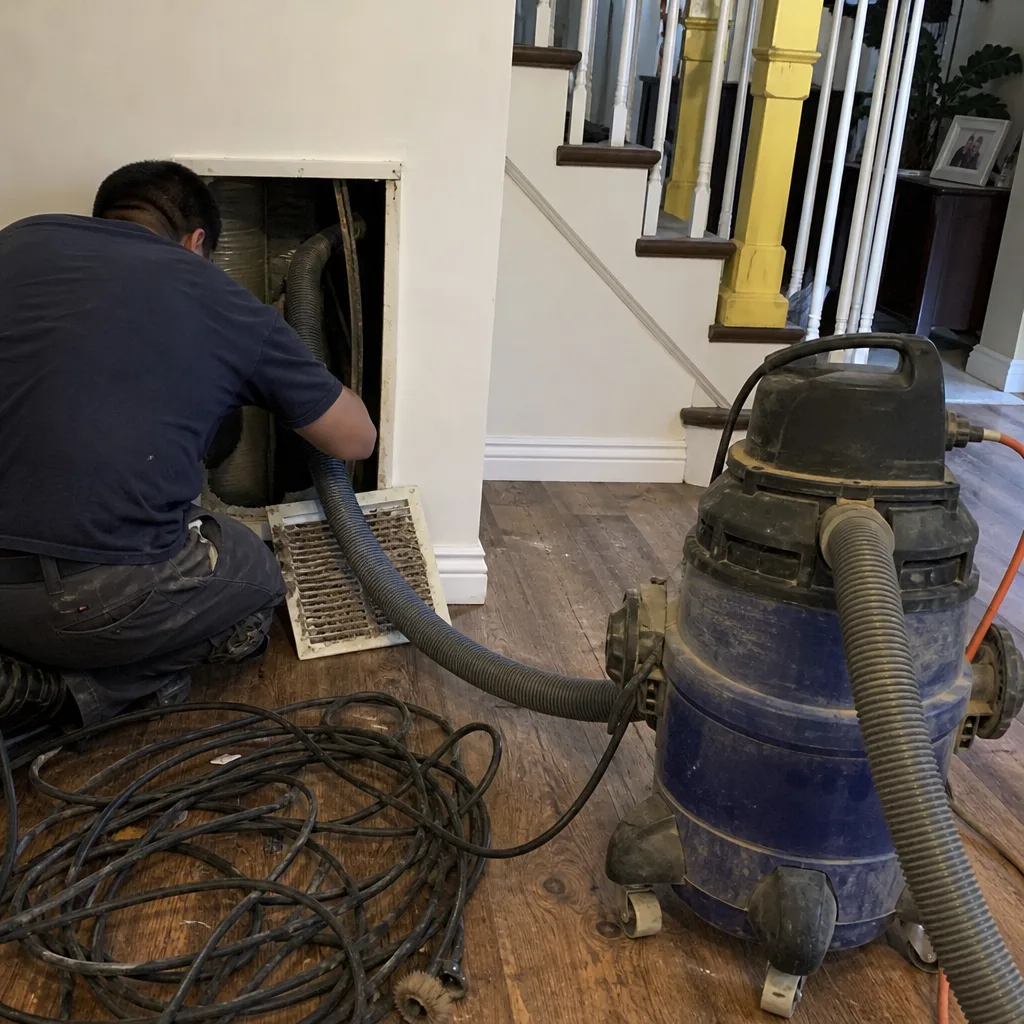 Before
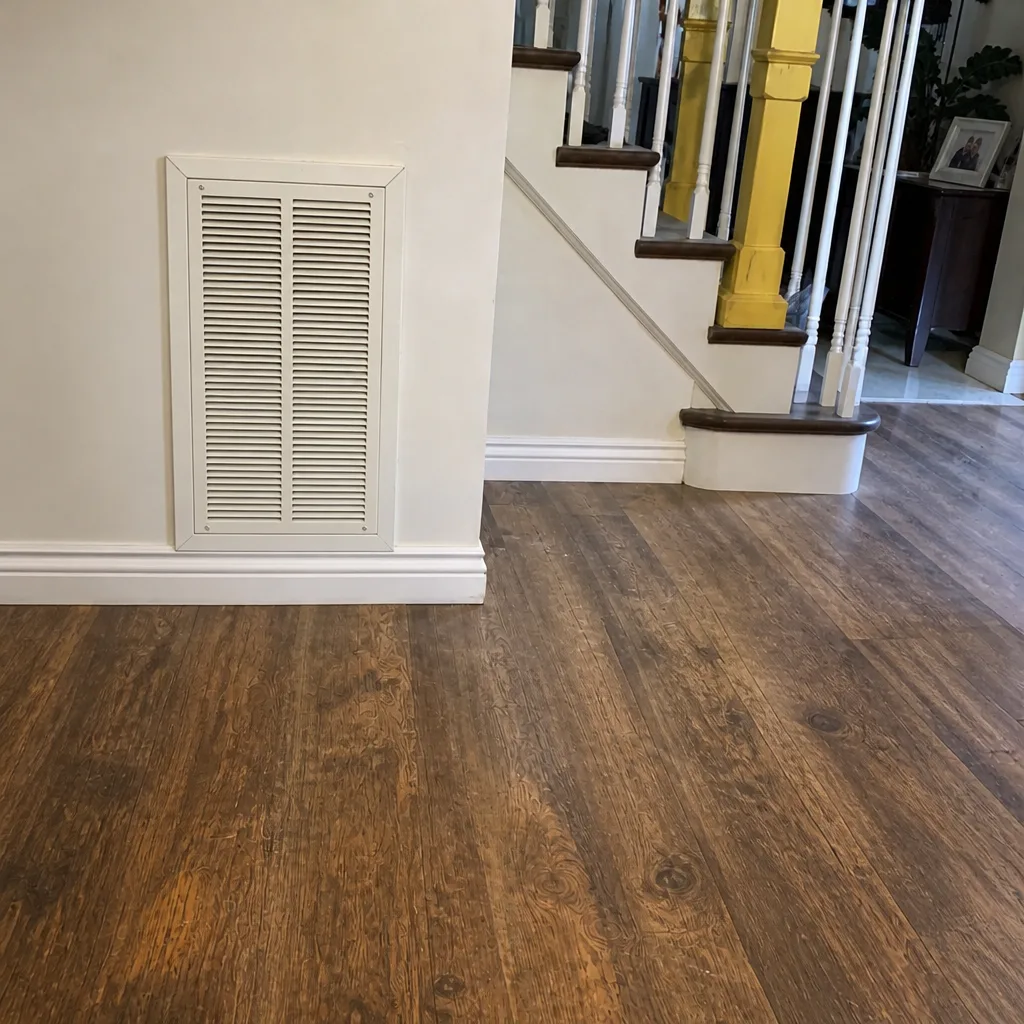 After
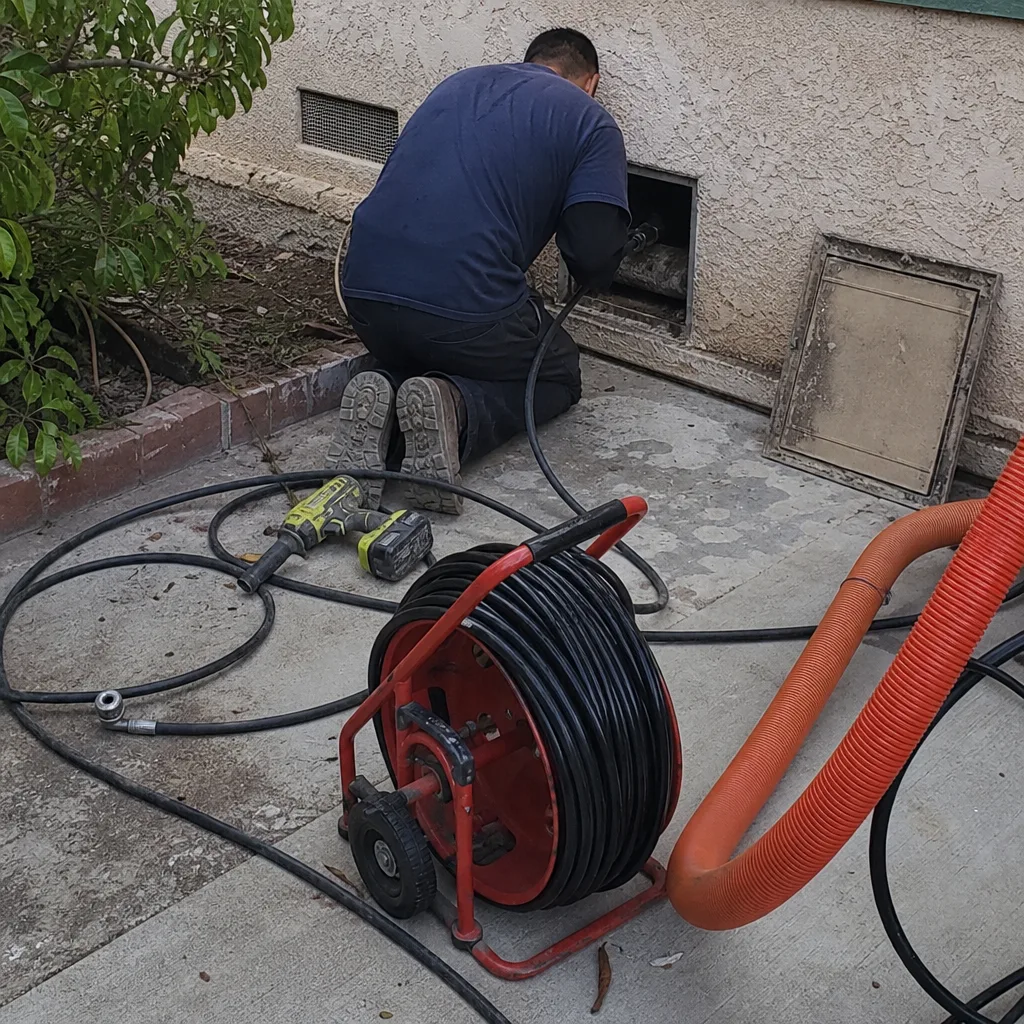 Before
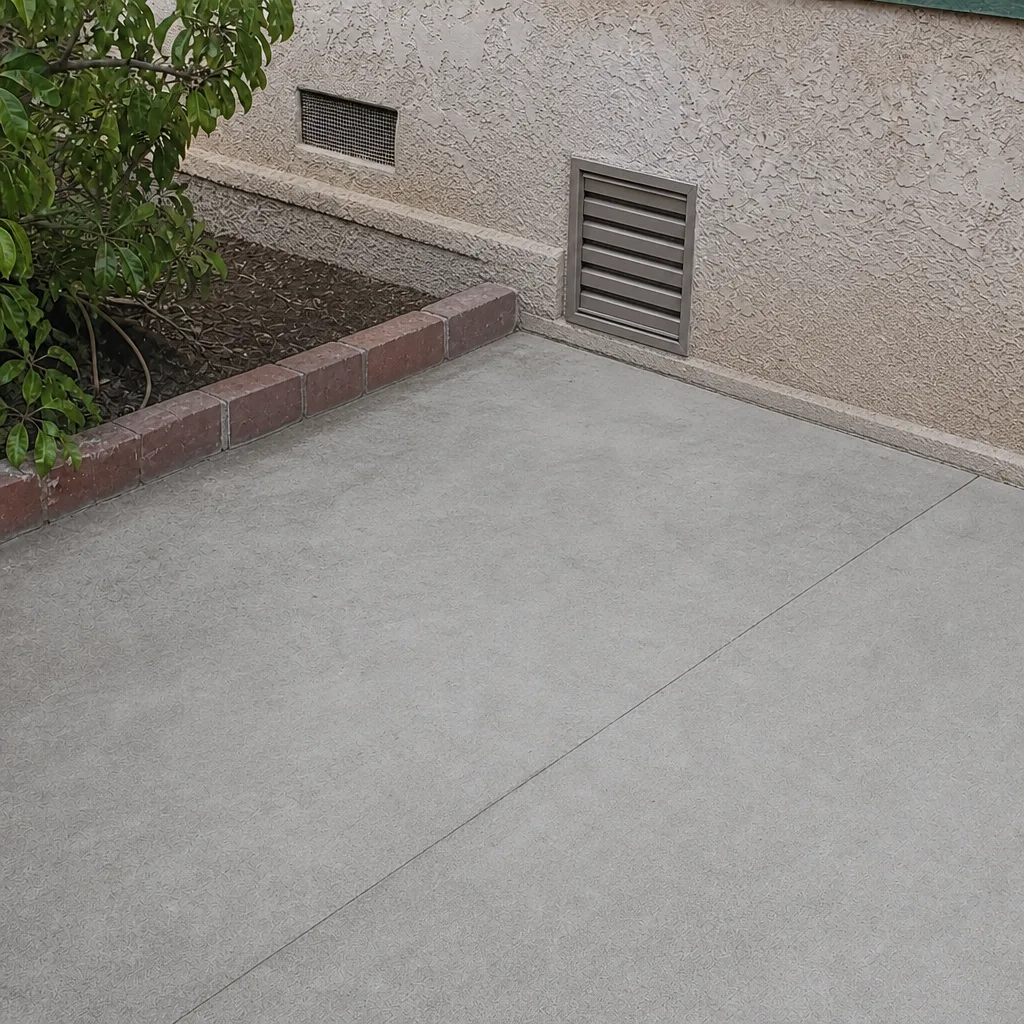 After
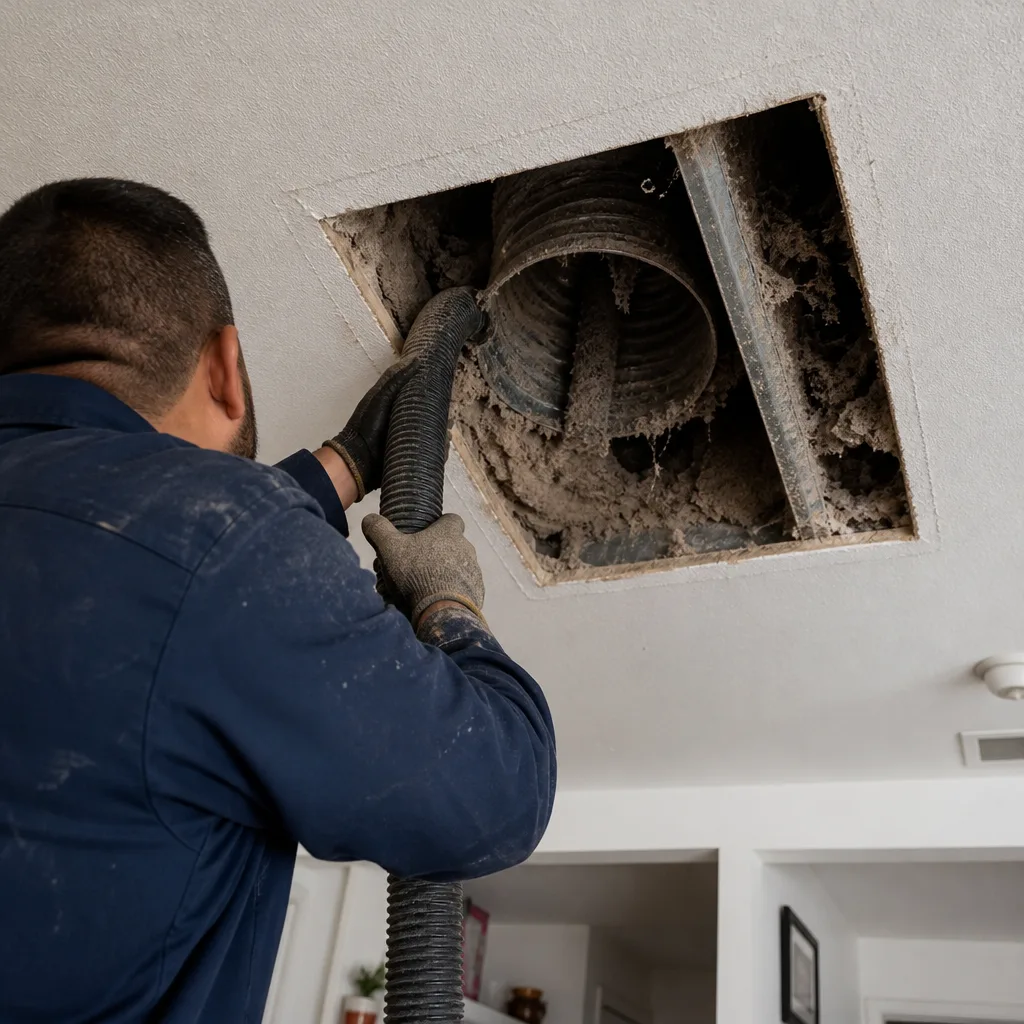 Before
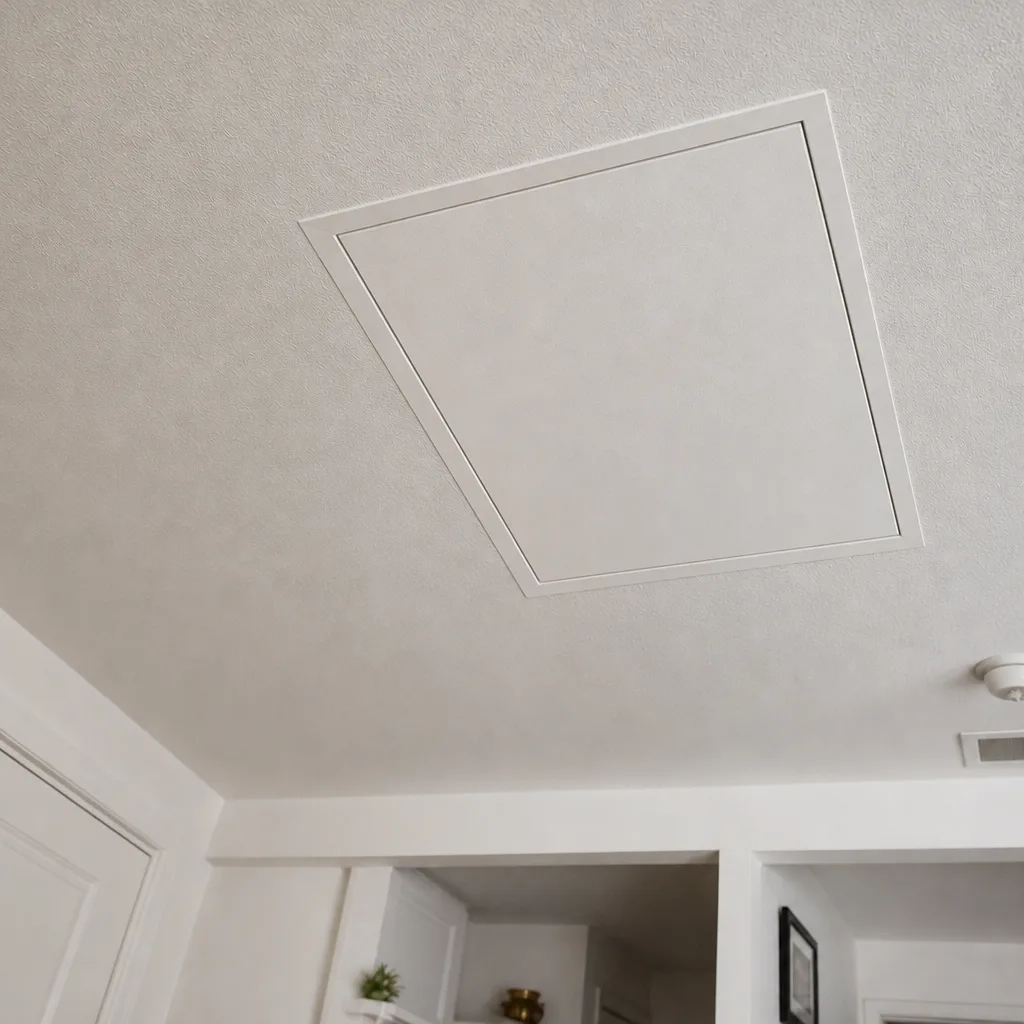 After
When to Call a Professional
You should call a professional duct cleaning company when any of these conditions are present: visible dust or debris at registers, a known renovation that introduced construction dust into the system, moisture or water damage in or around the ducts, visible mold growth on duct surfaces, unexplained respiratory symptoms that improve away from home, or dryer cycles that take noticeably longer than they used to. You should also call if you suspect structural damage: uneven room temperatures, weak airflow from specific registers, or unusual noises from the ductwork when the system runs. Duct Cleaning Pomona offers free estimates in Pomona, and the written estimate sets the price before any work begins. Call (833) 589-9571. We answer 24/7. Fast dispatch from 7am to 7pm, Sunday through Friday.
Frequently Asked Questions
Air duct cleaning in Pomona typically costs $400 to $1,500 depending on home size, number of systems, and system condition, with smaller single-story homes at the lower end and larger multi-system homes at the higher end. These are whole-system prices, not per-vent prices, and a legitimate company will provide a written estimate that sets the final price before work begins.
Cheap quotes come from companies using minimal equipment and skipping the parts of the system that matter most. A shop vac connected to a register doesn’t clean the coil, the plenum, the blower compartment, or the adhered film on duct walls, so the job costs less to perform and delivers much less. If the quote is per-vent, the final invoice is likely to be much larger than the initial number.
Ask for documentation. A professional company will show you what was found and what was removed, including photos or video from inside the ducts before and after the work. If a company can’t or won’t show you what they did, you have no way to verify the work, and that’s a deliberate choice on their part.
Not always. The EPA doesn’t recommend routine cleaning on a fixed schedule, but it does identify contamination, moisture, and damage as conditions that warrant action. If your ducts are clean, sealed, and dry, cleaning won’t change much. If they’re contaminated, damaged, or have seen moisture, cleaning restores the system to a baseline you can verify.
Sometimes, but not always. If uneven temperatures are caused by dust and debris restricting airflow to specific rooms, cleaning restores that airflow. If the cause is a crushed or disconnected duct, an undersized branch, or a return path problem, cleaning won’t help until the structural issue is repaired. That’s why a proper diagnostic pass before cleaning matters.
At least once a year for most Pomona homes, and more often if you have a long vent run, multiple bends, or a larger household that runs the dryer daily. The consequences of a clogged dryer vent are fires, not reduced efficiency, and an annual cleaning is cheap insurance against a problem that gives few warnings before it becomes dangerous.
The Bottom Line
Duct cleaning in Pomona is a real service with measurable benefits when it’s done properly and a waste of money when it isn’t. The homes here face a specific set of conditions: heat, Santa Ana dust, wildfire smoke exposure, and older housing stock with duct systems that have seen decades of use. What most of those systems need is contact cleaning with true negative-pressure extraction, combined with a structural assessment and repair capability, because cleaning a damaged system is a temporary fix. If you’re evaluating companies, ask about method, ask about equipment, and ask whether they can repair what they find. If they can’t answer those questions, that’s your answer. For a free estimate in Pomona, call (833) 589-9571. We answer 24/7. Fast dispatch from 7am to 7pm, Sunday through Friday.
Written by the team at Duct Cleaning Pomona, serving Pomona since 2015.