
Emergency Air Duct Cleaning Near Me: What Pomona Homeowners Should Do First
If you’ve just spotted rodent droppings at a floor register or a sudden musty smell pouring from your vents, the correct first step isn’t calling a duct cleaner. It’s shutting your HVAC system off immediately. Every minute that fan runs, whatever is in your ductwork is being aerosolized and pushed through every room in your house. Here’s the sequence that actually protects your home and your lungs, before any contractor arrives.
In Pomona, with our older housing stock and long cooling seasons, the instinct to “just get someone out here now” is understandable. But jumping straight to a booking without doing the first three steps can make remediation harder, more expensive, and less effective. If you’d rather skip the DIY triage and talk it through with someone who does this every day, call (833) 589-9571. We answer 24/7. Fast dispatch from 7am to 7pm, Sunday through Friday. Otherwise, here’s what to do first.
Step 1: Kill the System Before You Do Anything Else
The single most damaging move a homeowner makes during a suspected duct emergency is running the fan “just to see” if the smell clears or the debris settles. It doesn’t. It spreads. A central air handler in a typical Pomona home moves hundreds of cubic feet of air per minute through the supply side. If the contamination is biological, like rodent waste or visible mold growth on duct surfaces, you’re actively pressurizing that material and distributing it across furniture, bedding, and into the return air you’re breathing.
Go to the thermostat and switch the fan from “Auto” or “On” to “Off.” If the system is actively cooling, turn the whole thing off. Don’t just raise the temperature, because some thermostats will still cycle the blower for air circulation. You want the motor stopped. Then, if your home has floor registers, close them to create a physical barrier against further passive movement. For ceiling registers, leave them as they are, you don’t want to disturb accumulated debris yet.
The goal here is containment. A qualified technician will confirm this when you call, and any company that tells you to keep the system running while you wait is not one you want in your house. In our experience across Pomona’s slab homes and older raised-foundation bungalows, the ones that shut down fast have a much smaller cleanup radius than the ones that let the fan run for an afternoon.
Step 2: Identify the Affected Registers and Document What You See
Once the system is off, walk the house and note which registers show visible evidence. This might be staining around the diffuser, debris sitting on the grate, a smell localized to one room, or material that has blown onto the floor or walls nearby. Use painter’s tape and a marker to label the register covers from the outside if you can, so you don’t forget which ones you flagged.
Take photos before touching anything. Wide shots showing the register in context, close-ups of any debris or discoloration, and if there’s an odor, write down when you first noticed it and whether it worsens at specific times of day or in certain rooms. This documentation matters for two reasons. First, a trained eye can often look at the debris type and distribution pattern on your photos and tell you whether it’s construction dust, rodent activity, or something else entirely. Second, it creates a baseline. If you eventually need to file an insurance claim or dispute a previous contractor’s work, “before” photos are the only evidence you’ll have.
Don’t wipe anything up yet. Don’t vacuum the debris. Don’t spray disinfectant into the register. You’ll destroy the evidence a technician needs to properly scope the job, and in the case of rodent waste, you’ll kick up dust that can carry pathogens without the right containment in place. Your job right now is to record, not to clean.
Categorize the Problem: Biological, Mechanical, or Chemical
Not every duct emergency is equal. The response protocol differs depending on what you’re actually dealing with, and knowing the category upfront saves you from paying for emergency service you don’t need, or worse, under-responding to something that genuinely warrants it.
Biological contamination means mold, rodent or insect intrusion, or significant accumulation of organic dust. In Pomona’s climate, where the cooling season runs long and condensation can form inside poorly insulated duct runs, this category is more common than people expect. Rodent intrusion is particularly relevant in older neighborhoods where raised foundations and slab penetrations give pests entry points. If you see droppings, nesting material, or smell an acrid, musty odor, treat it as biological. The system stays off until a professional with proper extraction equipment assesses it.
Mechanical contamination covers post-construction debris, drywall dust, fiberglass insulation particles, or a duct section that has physically separated and is pulling attic or crawlspace air into the home. This is common after renovations in Pomona’s mid-century homes, where original duct runs get disturbed during remodels. The risk here isn’t pathogens, it’s particulate matter and the possibility that the duct system is structurally compromised.
Chemical odor intrusion means solvent smells, paint fumes, or something off-gassing that has been drawn into the return side and circulated. This often mimics a much scarier problem. A quick test is whether the smell persists with the system off and whether it originated near a specific event like painting, flooring work, or a spilled chemical in the garage. Chemical odors usually dissipate with ventilation and time, though thoroughly cleaning the duct surfaces and replacing the filter is still warranted.
What “Emergency Duct Cleaning” Actually Means for Scheduling in Pomona
Here’s the truth most companies won’t say outright: the vast majority of situations homeowners label as duct emergencies don’t require same-day service. They require same-day system shutdown, followed by a properly scheduled cleaning within a few days. That’s not a delay tactic. It’s the reality of doing the work correctly.
Genuine same-day urgency exists in a narrow band of scenarios. Severe rodent intrusion with active contamination in a home with young children, an immunocompromised resident, or an asthmatic family member. A mechanical failure where a collapsed duct run is pulling attic insulation directly into the living space. Smoke damage from a kitchen fire. These justify pulling a crew off another job for emergency response. A musty smell that’s been building for months, or a register with some dust buildup, does not, and any company that sells you “emergency” pricing for that scenario is taking advantage of your panic.
What a qualified company will want to know before they quote emergency work is telling. They should ask when you noticed it, whether the system has been running since, what the debris looks like, whether you have pets, whether there’s been recent construction, and whether anyone in the home has respiratory issues. If they quote a price before asking any of that, keep looking. A real emergency scope in Pomona starts with understanding the house, not with a number.
We answer 24/7 because a homeowner panicking at midnight deserves a human voice. Fast dispatch from 7am to 7pm means if your situation genuinely warrants it, we’re rolling Sunday through Friday. A call outside dispatch hours is booked into the next opening. But the phone is always answered, and you’ll always talk to someone who can walk you through the triage steps I just outlined.
Stabilizing a Rodent Situation in Pomona’s Older Homes While You Wait
Pomona has a significant inventory of slab-foundation tracts and older raised-floor bungalows. Both present rodent-intrusion points into ductwork. Raised foundations give rats and mice access to the crawlspace and, from there, into any duct run with a compromised connection. Slab homes have duct chases under concrete that can crack and admit pests from the soil. This isn’t scare-mongering, it’s the reality of housing stock that has been in place for decades.
If you’re in the biological category, likely rodent-related, here’s how to hold the line until a contractor arrives. Keep the system off. Close interior doors to isolate the affected rooms if you can identify them. If the weather is warm and you need cooling, use window units or fans that don’t pull air through the duct system, and keep them pointed away from the registers. Don’t run exhaust fans in bathrooms or kitchens any more than necessary, because negative pressure can draw air up from the crawlspace and through gaps in the duct returns.
And do not, under any circumstances, set traps inside the ductwork. We’ve seen this. It’s understandable in a moment of desperation but it makes the professional extraction more complicated and can leave a dead animal inside the system that you’ll be smelling for weeks. The pest control work happens at the entry points, in the crawlspace, and around the foundation. The duct cleaning happens after the animals are excluded. We can handle the duct side and work alongside whatever pest control service you’re using, but the sequence matters.
Questions to Ask Before Booking Emergency Duct Work
If you’ve done the triage, categorized the problem, and decided you need a professional, here’s the short list of questions that separate a legitimate operator from a blow-and-go truck that will be in and out in forty-five minutes. Ask them before you book.
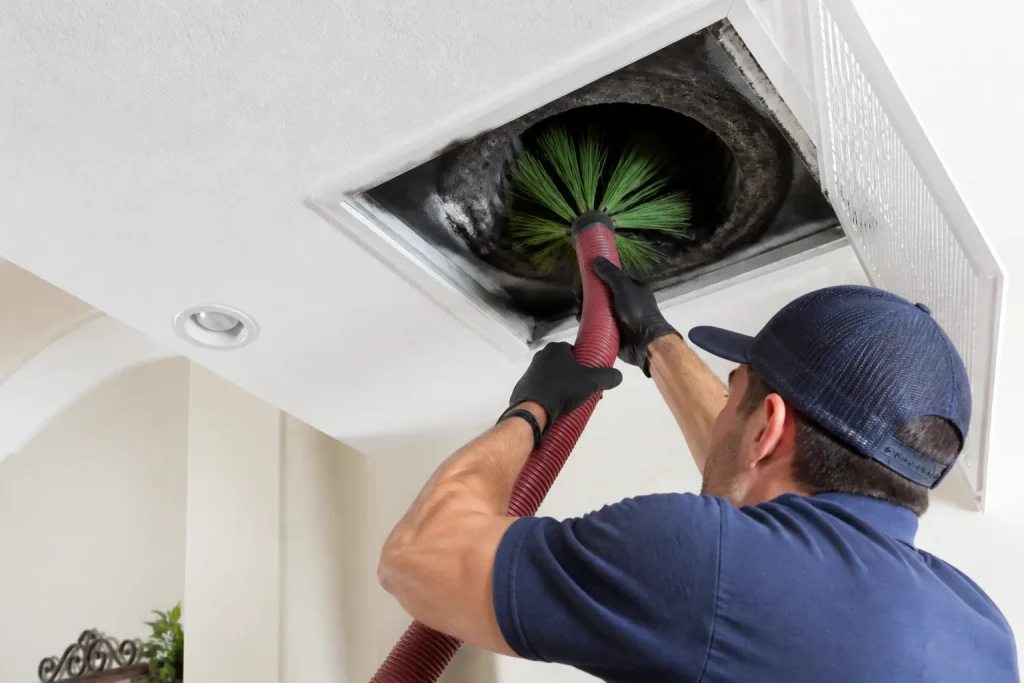
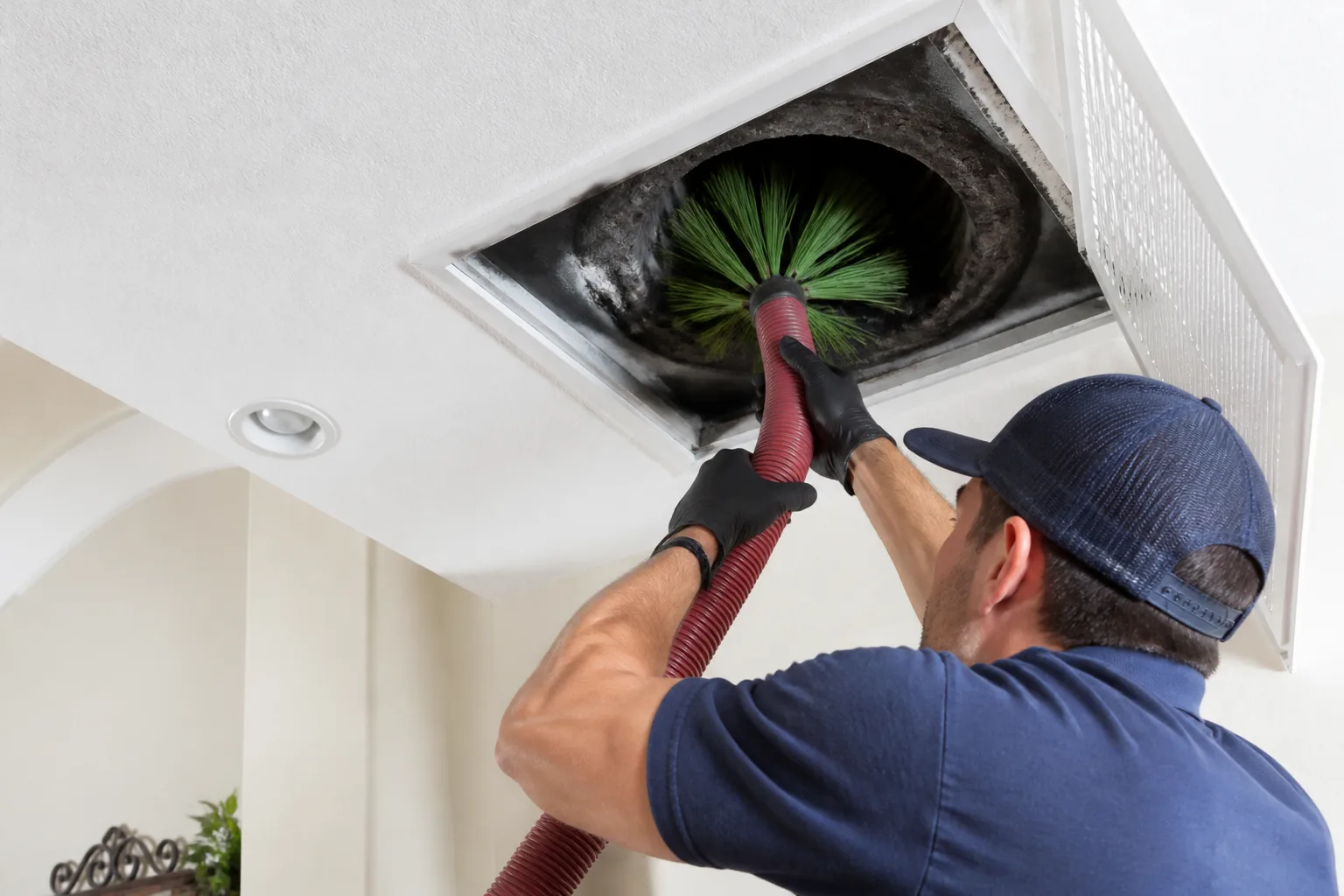
- “What equipment are you using to clean and extract?” If the answer is a generic “powerful vacuum” with no brand or method named, that’s a red flag. We run Rotobrush contact-cleaning brushes that physically scrub the duct walls, paired with Nikro HEPA negative-air machines that capture contaminants at the source rather than recirculating them into your living room. The lab-grade extraction standard matters, especially for biological contamination. We also work with Abatement Technologies filtration, which is the same standard you’d see specified in professional remediation environments.
- “Will you show me what’s in the ducts before and after?” A professional should have a scope camera and be willing to show you the interior of your ductwork before starting. After the work, you should see the same runs, now clean. If a company refuses or deflects this request, assume they have something to hide.
- “If you find damage while cleaning, can you fix it?” This is where our full-service approach to air duct cleaning matters in Pomona. Older duct systems often have separated joints, crushed runs, or deteriorated insulation that a cleaning crew discovers mid-job. If the company can only clean and not repair, you’re left with a half-finished job and a second contractor to hire. We cover air duct repair as part of our service, so a single visit can both clean and fix what’s found.
- “How do you handle the dryer vent while you’re here?” A separate but related concern. If you’re already dealing with airborne contamination in your duct system, your dryer vent deserves a look too. Lint accumulation is a fire hazard, not just an efficiency problem. We offer dedicated dryer vent cleaning as its own service, not an afterthought upsell. In Pomona’s older homes, where dryer vents often run long and through unconditioned space, this is one of the highest-value safety checks you can do.
When to Call a Pro (and When to Wait)
If your category is biological, especially rodent-related, or if you have a household member with a diagnosed respiratory condition, call now. Same-day response is justified and we’ll make it happen. If your category is mechanical and the duct system is actively pulling outside air into the conditioned space, that’s also a genuine priority. If you’re in the chemical category and the odor persists after a day of ventilation with the system off, it’s worth a professional assessment.
But if you’ve found dust at a register, or a smell you can’t quite place, and you’ve shut the system down, you have time to do this right. That time is your advantage. Use it to call around, ask the questions above, and pick the company whose answers don’t sound like a sales script. You already did the hard part by not running the fan.
And while you’re thinking about indoor air, the broader Duct Cleaning Pomona conversation applies here as much as anywhere. Our cooling season runs eight months in a good year. That’s eight months of recirculated indoor air. When the duct system is clean and intact, that’s fine. When it’s not, you’re breathing whatever is in there. The logic isn’t complicated.
If you’re in Pomona and dealing with a suspected duct emergency, or you simply want an honest assessment of what’s going on in your ductwork, call (833) 589-9571. The estimate is free, and we’ll tell you straight whether this is a same-day problem or a scheduled one. We answer 24/7. Fast dispatch from 7am to 7pm, Sunday through Friday.
The Bottom Line
The emergency isn’t the duct cleaning. It’s the hour of panic before you decide what to do. Shut the system down first, document what you see, categorize the contamination, and then make a clear-headed call. In Pomona, with our older slab and raised-foundation homes, the most serious situations are almost always biological, and they don’t improve by waiting. But they also don’t improve by rushing the wrong contractor through the door.
What you want is a company that names its equipment, shows you the before and after, and can repair what it finds. That’s the standard, whether the job happens today or next week. If you need help now, Duct Cleaning Pomona offers free estimates. Call (833) 589-9571. We answer 24/7. Fast dispatch from 7am to 7pm, Sunday through Friday.
Frequently Asked Questions
Yes, immediately. The fan is what distributes contamination from the ducts into the living space. Switch the thermostat fan to “Off” and shut the whole system down if possible. Close floor registers to create a barrier. Keep it off until a professional has assessed the situation and cleared you to restart.
Same-day service is warranted for active rodent intrusion, severe visible mold, a collapsed duct run pulling attic or crawlspace air into the home, or smoke contamination. A general musty smell, visible dust at registers, or a chemical odor from recent work usually allows for a scheduled appointment within a few days. A qualified contractor will ask detailed questions before pushing you toward a same-day visit you may not need.
No. Leave the debris in place. Do not vacuum it, wipe it, or spray anything into the register. You’ll destroy the evidence needed to properly scope the job, and disturbing biological material without containment can spread it. Photos are the right way to document, not physical cleanup.
Keep the system off and isolate affected rooms with closed doors. Use window units or fans for cooling if needed, pointed away from registers. Don’t run bathroom or kitchen exhaust fans excessively, as negative pressure can pull air from the crawlspace. Do not set traps inside the ductwork. Pest exclusion happens at entry points, and duct cleaning happens after the animals are gone. Call (833) 589-9571 and we’ll walk you through the sequence for your specific situation.
Written by the team at Duct Cleaning Pomona, serving Pomona since 2015.
Need Air Duct Cleaning Help?
Call Duct Cleaning Pomona - licensed & insured, with free written estimates in Pomona.
(833) 589-9571